
Beyond SEO: How to Make Your Business Visible in the Age of AI Search
For the past 2 decades, businesses were laser focused on optimizing their sites, earning backlinks and working their way up the results page. Ranking on the first page of Google was a straightforward path to visibility and almost a guarantee for traffic.
That relationship is rapidly changing. Plenty of businesses are watching their traffic decline despite no meaningful drop in their search positions and struggling to understand why. The answer has less to do with what Google thinks of your site and more to do with a fundamental shift in how people are finding information online. In 2026, the question isn't just whether you rank. It's whether AI recommends you.
The New Search Landscape
Today, upon inputting a search, users are increasingly met with a synthesized AI Overview at the top of the results page rather than a list of links to click through. The result is a drastically shortened user journey, with up to 68% of Google searches this year ending in zero clicks on individual websites.
Answer Engine Optimization (AEO) has fundamentally changed the mechanics of online search. For businesses that once built their digital presence around traditional SEO and organic traffic, AEO represents a structural change to how customers discover them.
The biggest strategic question for businesses to consider now is: who are your customers turning to for answers, and do they know you exist?
Who’s Answering Your Customers' Questions?
While Google remains the dominant search engine by volume, AI platforms like ChatGPT and Perplexity are capturing an increasingly significant share of the traffic that previously drove clicks to content sites. In fact, 37% of consumers now utilize AI as their primary starting point when searching, preferring the direct, conversational answers over wading through sponsored results and navigating multiple links on their own.
In 2025, 94% of B2B buyers were already using Large Language Models (LLMs) at some point in their purchase process, particularly to compare multiple vendors and inform their decision-making. If your brand is only optimized for traditional search, you are likely invisible during a significant portion of many users’ search journeys.
The major platforms your customers are using right now:
- Google AI Mode and AI Overviews: The highest-reach surface, answers are synthesized from crawled web content with a strong preference for sources that already rank well on traditional Google. A strong foundation in traditional SEO can still be helpful here.
- ChatGPT: With anywhere between 250 to 500 million queries per week, ChatGPT has quickly become one of the most visited properties on the Internet. Citations are drawn from a wide range of sources, with a notable preference for sites like Wikipedia and Reddit, emphasizing credibility and structured content.
- Claude: As the second-largest AI referral source for B2B brands, Claude favors clear and logical content that is factually consistent. In-depth and authoritative content is prized over ambiguous statements and generalized language.
- Perplexity: Though it is much smaller in scale, Perplexity is known for its unusually high conversion rate, indicating that its users are likely to be closer to making a decision upon starting their search. Perplexity skews towards up-to-date sources with a clear topical focus.
How AI Decides Who to Trust
Here's where AI search differs most fundamentally from traditional search: rather than ranking the pages that best match a keyword, AI systems generate answers they believe to be accurate by citing the sources they consider most credible. It’s less about whether your page is optimized for a keyword and more about whether the AI trusts your brand enough to recommend it.
AI search engines rely on trust signals: machine-readable data points that allow for mathematical evaluation of which brands are credible, accurate and the leading authority in their field. No single factor determines whether your brand gets cited; what matters most is the overall picture your brand presents across the web.
Examples of trust signals include:
- Content from identifiable verifiable experts: AI systems consistently favor content attributed to real people with demonstrable credentials and a published track record. Anonymous or generic content ranks lower in AI credibility, regardless of how well it's written.
- Consistency across sources: When multiple independent sources make the same claims about your brand, AI confidence in citing you goes up. The same applies for when your content can be cross-referenced with other authoritative material. Inconsistencies in how your business describes itself, or claims it makes that can't be verified elsewhere, introduce doubt that pushes you down the citation stack.
- Transparency cues: Businesses that make it easy for customers to understand their pricing, process, and terms are consistently surfaced more readily. AI prioritizes sources that help users make informed decisions, so the clearer your website is about what you do and what it costs, the more useful you look to an AI generating a recommendation.
The 3 Layers of AI Visibility
It can be helpful to think of your brand’s AI footprint in 3 layers:
- Your own website: This is content you control directly. Service pages, blog posts, team bios and so on. It’s where most SEO and AEO work happens, but is insufficient on its own. Our CRO framework ensures your site is crawlable, reflective of real search behaviour and scalable with your brand’s long-term growth.
- Platforms you publish on: AI systems look beyond your own site to understand who you are and what you’re known for. Expand your brand’s footprint with guest posts, podcast appearances and content on social media platforms such as LinkedIn.
- Third-party mentions: The layer over which you have the least direct control over, yet often the layer with the most influence on AI trust. From Reddit comments to polished media coverage, getting mentioned by more sources carries significant weight for your brand.
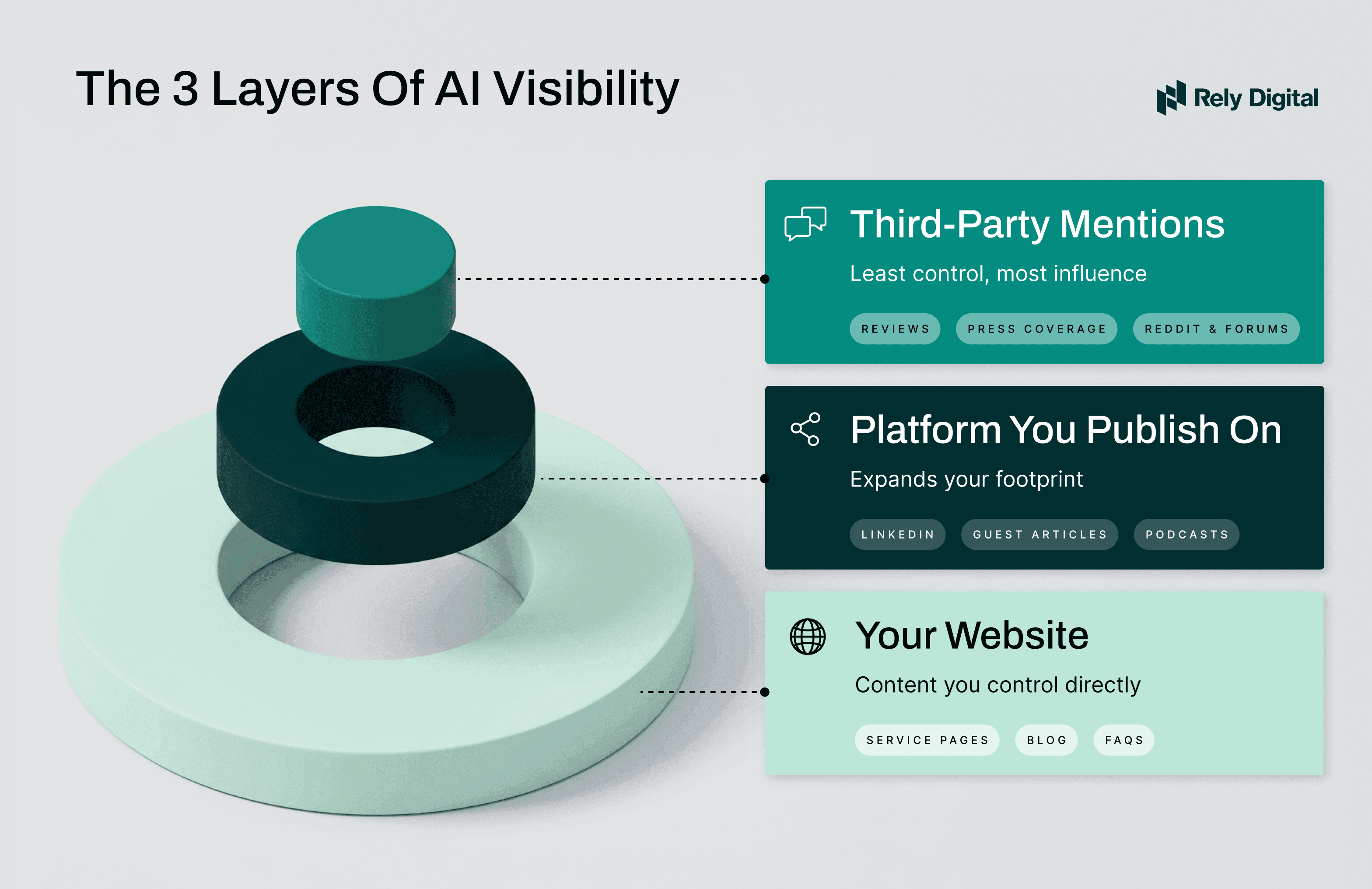
Most businesses only actively manage the first layer, but the brands that show up the most consistently in AI results aren’t necessarily the ones with the best websites. They focus on creating a complete and consistent presence across all 3 layers.
How to Start Building Compounding Visibility
Unlike paid advertising, which stops the moment your budget does, AI visibility compounds.The more credible your brand becomes across the web, the more consistently AI systems will surface you. In turn, the more they surface you, the more your authority grows. Here's where to start.
Your Website Is Your Foundation
Before worrying about what third parties are saying about you, make sure your own site provides AI systems with the clearest possible picture of who you are and what you do. That means:
- Clear, specific service descriptions that directly answer the questions your customers are asking
- Author attribution on all content, with brief bios that establish expertise
- FAQ sections on key pages. These are highly crawlable and frequently pulled into AI answers
- Up-to-date, accurate business information: hours, location, services, pricing where possible
Not sure how your site stacks up for AI discoverability? Our team audits your current presence across traditional search, AI Overviews, and LLM platforms.
Build Your Published Footprint
AI systems build their understanding of your brand from everything they can find, not just your website. Businesses that consistently produce content in multiple places (such as LinkedIn, industry publications and webinars) give AI more data points to work from, and more opportunities to be associated with the topics they want to own.
Key high-leverage moves we recommend:
- Publish opinion pieces/contributed articles in your industry's key publications
- Ensure your leadership team has credible, active LinkedIn profiles
- Seek opportunities to be quoted or interviewed in trade media
Each mention in a credible context reinforces your brand's authority in the eyes of an AI.
Make Your Results Visible
Skip the generic praise. AI systems place heavy weight on social proof, drawing upon what real people say about your business across the web. You can't control what third-party reviewers write, but you can build a strong first-party record of outcomes.
Dedicate a section of your website to case studies that reference specific clients and measurable results. Clearly frame the before and after: what was the client dealing with before they came to you, how did you solve it, and what changed as a result? Concrete numbers and named outcomes are far more credible to both AI systems and human readers than vague testimonials.
Want to see what this looks like in practice? Check out our case studies.
Traditional SEO still has its place in brand discoverability. Your technical foundation, keyword strategy, and backlink profile continue to play an important role, especially for Google. But the businesses that will own visibility over the next few years are the ones that think beyond the SERP: building real authority, earning third-party credibility, and giving AI systems a comprehensive and compelling picture of who they are.
Rely Digital specializes in technical audits, content strategy and multi-platform visibility tracking. If you’re questioning where your brand stands in the age of AI search, book a prompt analysis with our experienced strategists.
Frequently Asked Questions (FAQ)
Is SEO still worth investing in if AI search is growing?
Yes. The two aren't as divisive as they might seem. A strong SEO foundation (clean technical structure, quality content, authoritative backlinks) still signals credibility to AI systems, particularly Google's AI Overviews. Traditional SEO and AI visibility strategy are complementary. The risk isn't in doing SEO; it's in doing only SEO and ignoring the additional signals AI platforms rely on.
How does AEO impact website traffic?
Many businesses have experienced a sharp decline in click-through rates (CTR) as AI tools increasingly enable users to easily obtain answers through the AI chat interface itself, reducing the need to click on external webpages. However, traffic directed from AI-generated answers converts at a significantly higher rate. Since the AI platform has already “screened” and summarized the most relevant information for the user, those that do click onto your website are more likely to be high-intent and ready to purchase.
How long does it take to see results from AI visibility work?
AI visibility compounds over time. While it’s not an overnight fix, it's also not as slow as traditional SEO link-building. Structural improvements (schema markup, author attribution, FAQ sections) can affect how AI crawlers interpret your site within weeks. Building the broader content and third-party footprint that drives long-term citation authority takes longer, typically three to six months before you see consistent improvement.
About the Author

Rafael is the Growth & SEO Lead at Rely Digital, where he drives search and web optimization across healthcare, travel, retail, and more. His background spans over 8 years in digital marketing, 4 years as an educator, and specialized credentials in AI for business applications, a combination that informs his focus on future-proofing brands for both traditional search and the rise of Answer Engine Optimization (AEO).