What Is an SEO Audit? 5-Pillar Framework & AI Search Roadmap
You’ve been publishing content regularly, but your rankings aren’t moving. Web traffic is flat, your organic pipeline is cold, and when you ask ChatGPT or Gemini about your industry, competitors show up instead of your brand.
Something is off, but you're not entirely sure what. This is where an SEO audit comes in.
An SEO audit is a comprehensive analysis of your website designed to identify exactly why search engines aren't ranking you as well as they could be. Think of it like a car inspection. Your car might be running, but it's not necessarily performing at its best. A mechanic doesn't guess. They run diagnostics, identify the specific issues, and give you a roadmap to fix them. The same goes for an SEO audit.
Here is how real digital strategists approach a modern SEO audit, including the five-pillar framework and the step-by-step process we follow with our own clients.
Key Takeaways
- A good SEO audit goes beyond tool exports. It's a diagnostic of your site's technical health, content, structure, and authority, validated by someone who knows what the data means.
- An audit uncovers opportunities, not just problems: keyword and content gaps against competitors, pages close to page one, and places where your site loses conversions.
- In 2026, ranking isn't enough. An audit should also measure whether AI search tools like Google AI Overviews, ChatGPT, Gemini, and Copilot cite your brand.
- The value of an audit is in prioritization. Findings should be ranked by impact and effort so your team knows what to fix first.
What Does an SEO Audit Actually Cover in 2026?
An SEO audit is a structured review of how well your website can be found, understood, and chosen by search engines and AI assistants. It identifies what's holding you back and where you have room to grow, then ranks each finding by business impact so your team knows where to start.
Until recently, audits focused on three areas: technical SEO, on-page content, and backlinks. That's no longer the full picture. Google now shows AI Overviews for a large share of searches, and buyers are asking ChatGPT and Gemini for recommendations before they ever visit a website. At Rely Digital, every audit we run reviews both traditional rankings and AI search visibility, because your buyers are finding answers in both places.
What an SEO Audit Uncovers
Issues Holding You Back
- Crawl errors and blocked resources: Pages Google can't access, robots.txt misconfiguration, or crawl depth issues that prevent important pages from being indexed
- Slow pages and Core Web Vitals: Slow loading times, large image files, or poor mobile responsiveness that hurt both rankings and user experience. Reports show that only 48% of websites pass all three Core Web Vitals on mobile, while 72% of websites have slow pages, 95.2% have redirect issues, 59.5% have missing H1 tags, and 80.4% have missing image alt attributes.
- Duplicate content and canonicalization issues: Multiple versions of the same content competing for rankings instead of consolidating authority
- Orphaned and poorly linked pages: Pages with no internal links pointing to them, which search engines struggle to find and rarely rank
- Broken internal linking: Orphaned pages that don't link back to your content hierarchy, wasting potential link equity. 67% of enterprise and mid-market websites suffer from orphaned pages, effectively rendering a significant portion of their content completely invisible to search indexers.
- Thin or missing content: Pages that lack sufficient depth, don't answer user intent, or have minimal value relative to ranking difficulty
- Broken tracking: GA4 events or form submissions that aren't being recorded, so you can't tell which pages actually generate business.
Opportunities You’re Not Capturing
- Competitor keyword gaps: Valuable keywords your competitors rank for that you don't have a page for.
- Pages close to page one: Pages ranking in positions 8 to 20 that often need only better content, internal links, or an improved title to break through. These are usually the fastest wins in any audit.
- Content gaps: Questions your buyers ask that no page on your site answers well.
- Backlink gaps: Sites linking to several of your competitors but not to you.
- Search features you could win: Featured snippets, People Also Ask boxes, and local results where the right formatting or schema can earn you extra visibility.
- AI citation opportunities: Questions where AI tools cite your competitors, and where clearer, better-structured content could get you cited instead.
The Benefits of An SEO Audit
Most businesses already invest in SEO. But without a clear understanding of what's working against them, publishing more blog posts and tweaking title tags is often a waste of budget. A strategic audit gives you:
- A clear plan instead of guesswork: You know exactly which fixes will move the needle and in what order, so your team spends time on work that matters.
- More qualified leads, not just more traffic: An audit aligns your pages with high-intent searches and removes conversion friction, so organic traffic turns into real business at a lower cost per lead.
- A competitive edge: You see where competitors are winning and where they're vulnerable, and you get a plan to close the gap.
- Visibility in AI search: You learn whether AI tools mention your brand, and what to change so they cite you when buyers ask for recommendations.
- Protection during redesigns and migrations: Relaunching a site without an audit is one of the fastest ways to lose years of built-up rankings. An audit maps redirects, canonicals, and tracking before launch, so nothing breaks on the way.
The 5-Pillar SEO Audit Framework
At Rely Digital, we structure every technical and strategic audit across five core pillars:
The Step-by-Step SEO Audit Roadmap
An audit can produce hundreds of findings. A phased process keeps it focused and prevents decision paralysis when the list gets long.
Phase 1: Goals, Baseline & Tracking
Before touching a crawler, we confirm what success looks like and whether it's being measured correctly.
- Define business goals: Which services, products, or locations matter most? An audit for a clinic that needs bookings looks different from one for a SaaS company that needs demo requests.
- Verify tracking: Confirm that GA4 key events, form submissions, and phone calls are recorded correctly. If tracking is broken, every recommendation that follows is based on bad data.
- Set a baseline: Record current rankings, clicks, impressions, conversions, and AI visibility so you can measure progress later.
Phase 2: Technical Crawl & Indexing
Confirming that search engines can actually crawl and index your site is crucial before beginning to analyze content quality.
- Run a full crawl: Use a crawler like Screaming Frog or Sitebulb to map every indexable and non-indexable URL.
- Compare with Google's view: Cross-check the crawl against Search Console's Page Indexing report to find pages Google ignores or excludes.
- Review Core Web Vitals: Check Largest Contentful Paint (LCP), Interaction to Next Paint (INP), and Cumulative Layout Shift (CLS) using real user data, starting with your highest-traffic pages.
From our audits: On one SaaS audit, we found a platform-level rule in the site's robots.txt telling every search engine not to crawl the site, sitting directly above the custom rules meant to allow it. On top of that, several key pages pointed their canonical tags at a staging domain. The site looked fine to visitors, but search engines were getting mixed signals about what to index, and no content update would have fixed that. In another audit, an e-commerce brand's organic traffic decline came down to more than 3,000 broken URLs and thin product content, not backlinks or site speed, which is where most people look first.
Phase 3: Content, Intent & Competitor Analysis
Search engines and AI tools don't reward generic content. This phase checks whether your pages match what people are searching for and how they compare with your competitors.
- Find content decay: Identify pages whose clicks and impressions have dropped steadily over the past 6 to 12 months.
- Fix keyword cannibalization: When two or more pages compete for the same query, merge them into one stronger page or give each a distinct purpose.
- Map competitor gaps: Compare your keywords, content, and backlinks with your top 3 to 5 competitors to see where they win and where you can take ground.
- Add unique value: Update your best pages with original data, expert insight, and a clear point of view. Search engines and AI tools reward content they can't find elsewhere.
From our audits: An IT services client wanted to rank for "AI services." When we analyzed the search results, the term was dominated by AWS, Azure, and Oracle, and the people searching it were looking for cloud AI platforms, not a partner to help their business adopt AI. Even if the page had ranked, it would have attracted the wrong audience. Instead, we built the page around "AI consulting services," a narrower term that matched exactly what the client's buyers were searching for and was realistic to win. Choosing the right keyword matters as much as optimizing for it.
Phase 4: Architecture, UX & Internal Linking
Internal links control how authority flows through your site, and your page structure decides whether visitors find the next step.
- Reduce page depth: Keep every priority page within 3 clicks of the homepage.
- Improve anchor text: Replace "click here" and "learn more" with descriptive anchors that explain what the linked page is about.
- Review conversion paths: Check that every key page has a clear next step and that forms and booking flows work on mobile.
- Prune or consolidate weak pages: Rewrite, merge, or remove low-value pages with no traffic and no backlinks, using 301 redirects or 410 status codes.
Phase 5: AI Search Visibility
This is the phase most audits still skip, and it's where many businesses have the most room to grow.
- Check AI Overview performance: Google Search Console now includes generative AI performance reports showing how often your pages appear in AI Overviews and AI Mode. Bing Webmaster Tools offers a similar AI Performance report for Copilot citations.
- Test real prompts: Ask ChatGPT, Gemini, and Perplexity the questions your buyers ask, and record who gets cited.
- Check AI crawler access: Make sure robots.txt isn't blocking crawlers like OAI-SearchBot or PerplexityBot, and that your key content is visible without JavaScript.
- Track AI referrals: Set up GA4 to separate traffic from chatgpt.com, gemini.google.com, and perplexity.ai so you can see whether AI visibility turns into leads.
Phase 6: Prioritize With an Impact vs. Effort Prioritization Matrix
An audit is only useful if your development and content teams can actually execute it. We recommend grouping every finding into an impact vs. effort matrix:
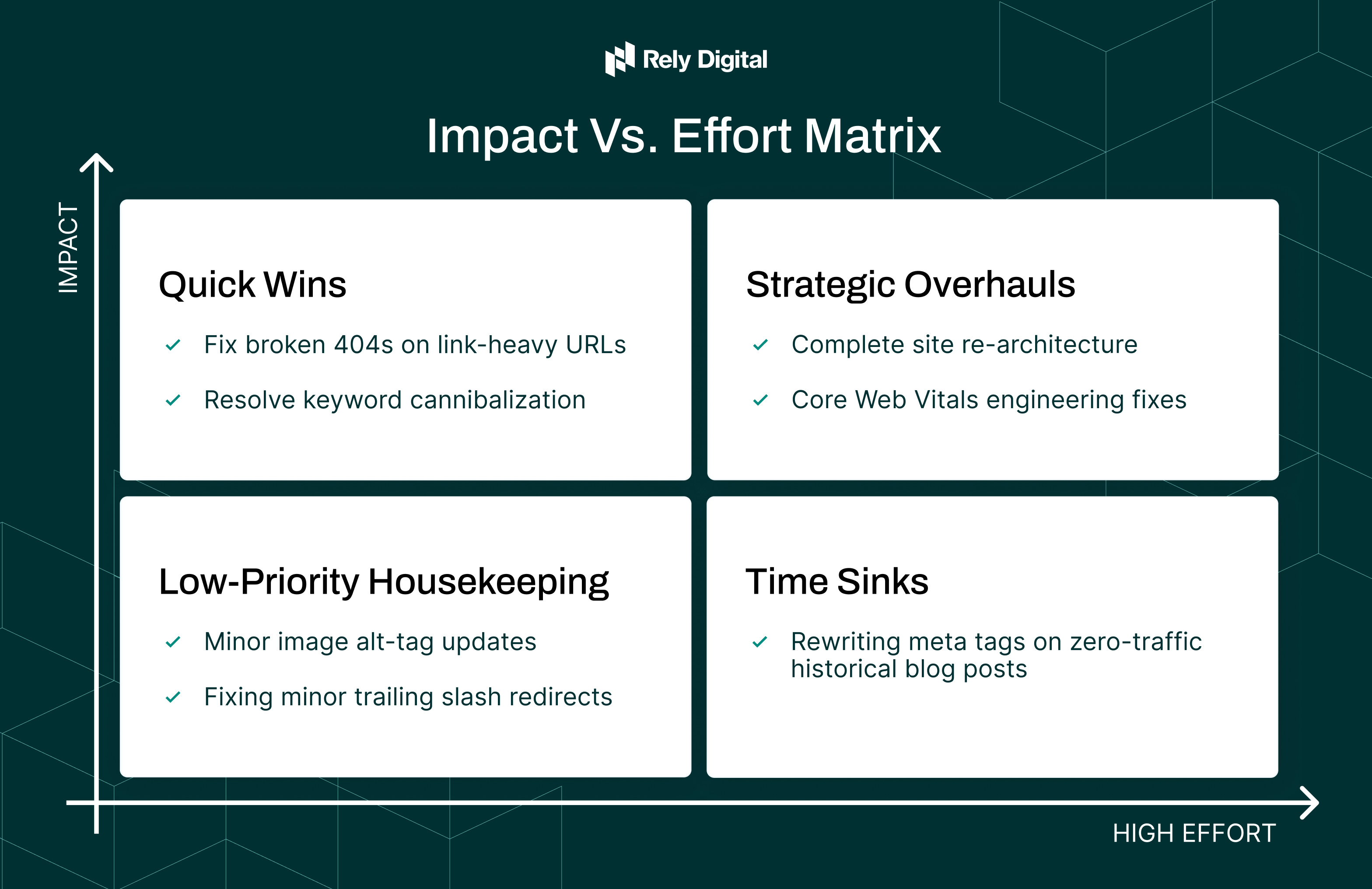
Quick Wins (high impact, low effort) should be executed immediately. These often include fixing redirect chains, correcting canonical tags on key pages, and rewriting titles on pages ranking in positions 8 to 20.
Strategic Overhauls (high impact, high effort), such as restructuring site architecture, consolidating content hubs, or building an AI visibility content plan, can be scheduled into sprint cycles.
Once your main bottlenecks are fixed, turn to Low-Priority Housekeeping (low impact, low effort). Time Sinks (low impact, high effort) can be deprioritized or dropped.
Common SEO Audit Pitfalls to Avoid
Trusting the tool's "all clear." Tools like Screaming Frog, Semrush, and Ubersuggest are great for finding problems, but they only check what can be measured, like length, duplicates, and missing tags. They can't tell you whether a tag actually works.
For example, say a service page has the title tag "Our Services | Brand Name." It's between 30 and 60 characters, it's unique, and it isn't missing, so no tool will flag it. But where's the keyword? Nothing tells Google or the searcher what the page is about, where the business operates, or why they should click. Compare it with "Commercial Plumbing Services in Kelowna | Brand Name." Same length range, but now it targets a real search, includes the location, and matches what the buyer is looking for. There's another catch: when a title is this vague, Google often rewrites it with its own version, so you lose control of how your page appears in results.
Meta descriptions have the same problem. "Welcome to our website. We are committed to providing quality services to our valued customers..." can land within the ideal 150 to 160 characters and pass every check, but it gives nobody a reason to click. Tools find the issues. People judge whether something works.
Focusing only on volume. "Publish 100 more blog posts" isn't an audit recommendation. More content helps only when the technical foundation and the existing content are solid.
Ignoring search intent. A page that ranks for the wrong intent brings visitors who don't convert. Rankings matter only when they bring the right people to the right page.
Ignoring AI search. An audit that only looks at traditional rankings misses where a growing share of buyers now start their research.
Setting unrealistic expectations. If SEO has been neglected for two years, it won't be fixed in two weeks. A good audit comes with a realistic timeline.
How Rely Digital Runs an SEO and AI Visibility Audit
Most audits end with a long tool export and no clear next step. Ours end with a plan your team can act on right away.
Every audit is led by our organic team, and each finding is checked manually instead of copied from a tool. You get three deliverables:
- An audit playbook: Every finding organized by pillar and ranked by impact and effort, so your developers and content team know exactly what to fix first.
- A strategy document: The reasoning behind each recommendation, plus a competitor analysis showing the keywords, content, backlinks, and AI citations your competitors have that you don't.
- A findings presentation: A live walkthrough with our team, so nothing gets lost in a file and you can ask about every priority.
Depending on the size of your site, an audit takes from a few days to about two weeks, including the presentation.
What this looks like in practice: When Hayer Health, a family-run physiotherapy clinic in South Vancouver, came to us, it was competing with more than 400 physiotherapy providers, had an average Google ranking of #42 (page 4), and had no presence in AI answers. We started with a full audit, then acted on the findings with technical fixes, service page optimization, targeted content, and Answer Engine Optimization (AEO). Within a year:
- Average Google position improved from #42 to #18
- Google search impressions grew 70% (and 68% on Bing)
- AI Overview appearances reached 4,440 per month
- The clinic started receiving bookings from people who found it through ChatGPT and Gemini
Read the full case study here.
If your rankings have stalled or you're not sure how your brand shows up in AI search, an audit is the right place to start. Request your SEO and AI visibility audit and our team will show you exactly where your growth is hiding.
Frequently Asked Questions (FAQ)
How often should a small business conduct an SEO performance review?
Small businesses should review SEO on a tiered schedule to catch technical issues early without overreacting to daily metric fluctuations. Run quick monthly health checks to monitor organic traffic trends and lead conversions in Google Search Console, shift to quarterly strategic reviews to evaluate keyword movements, backlink health, and content decay, and conduct a full-scale technical audit once a year or prior to major site redesigns.
How long does an SEO audit take?
It depends on the size of the site. A small business website can be audited in a few days. A large e-commerce or enterprise site with thousands of pages can take up to two weeks, including analysis, competitor research, and presenting the findings.
What are the benefits of hiring an external agency for an SEO audit?
While it’s possible to run an audit yourself using tools like Semrush or Ahrefs, it requires SEO knowledge to interpret results meaningfully. Many businesses do basic audits internally and bring in an agency when they want deeper competitive analysis or have competitive keywords where they need an expert eye. If you have the budget, an agency audit is faster and more thorough.
Are there free online resources to check my website's SEO performance?
Google Search Console is a great starting place for first-party data on organic clicks, indexation status, and search queries, alongside PageSpeed Insights for measuring load speeds and Core Web Vitals. You can also leverage the free tier of Screaming Frog to crawl up to 500 URLs for broken links, missing title tags, and duplicate content.
About the Author

Rafael is the Growth & SEO Lead at Rely Digital, where he drives search and web optimization across healthcare, travel, retail, and more. His background spans over 8 years in digital marketing, 4 years as an educator, and specialized credentials in AI for business applications, a combination that informs his focus on future-proofing brands for both traditional search and the rise of Answer Engine Optimization (AEO).